Western Wall Rabbi declares daily labor the primary path to spiritual elevation
Citing the Kotzker Rebbe and the midrashim of Abraham, the rabbi argues that the physical world is not an obstacle to faith but the vessel for it.
By Sakura McCarthy ·
Rabbi of the Western Wall and holy sites stated that the core mission of humanity is to transform the physical world into a spiritual one. He rejected the notion that spirituality requires escaping daily life. Instead, he argued that the body and material surroundings are the primary tools for fulfilling spiritual obligations.
The rabbi quoted the Kotzker Rebbe, who interpreted Psalms 115:16 as a directive to take the earth given to mankind and make it into heaven. He defined the heavens as the spiritual domain and the earth as a trust entrusted to humans to cultivate. This framework positions everyday existence as a service to the Creator rather than a distraction from it.
To illustrate this principle, the rabbi pointed to the life of Abraham, the founding Patriarch. He cited a midrash from Genesis 18:7 regarding Abraham’s hospitality. The text describes how a calf ran ahead of Abraham all the way to Hebron and entered the Cave of Machpela. Abraham followed the animal and saw Adam and Eve lying in the cave with candles burning before them.
According to the Zohar, as interpreted by Rabbi Shimon bar Yochai, the Cave of Machpela serves as the entrance to the Garden of Eden. Adam, after his expulsion, smelled the fragrance of the Garden near the cave and asked to be buried there with Eve. The rabbi noted that the name Machpela derives from a root meaning duality, reflecting the burial of couples and the side-by-side existence of spiritual and material dimensions.
The rabbi connected the location to the city of Hebron, whose Hebrew name relates to connection. He described the cave as a symbol for the mission passed down to the Jewish people: to make faith tangible through action. He emphasized that the cave is not merely a burial site but a representation of uniting the earthly and the heavenly.
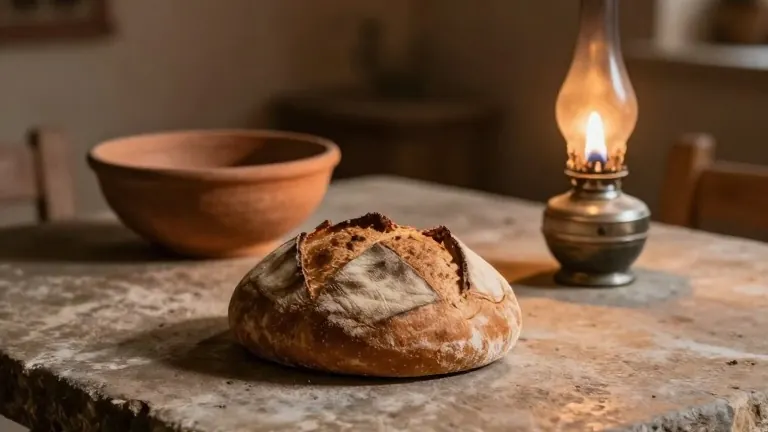
The rabbi detailed how Abraham’s ordinary acts of hospitality generated profound spiritual effects. When Abraham saw three men, he prepared an elaborate meal. The midrash from Exodus Rabbah states that in the merit of Abraham’s words to Sarah, “Knead and make cakes,” the Holy One later rained down manna for the Children of Israel in the wilderness.
The rabbi explained that Abraham and Sarah elevated the material world through their actions. By preparing food for the angels, they drew heavenly blessing into the physical world. This exchange resulted in the manna, described as the bread of the mighty, becoming physical sustenance for the Israelites during their journeys.
He concluded that spirituality is expressed through the simplest deeds, such as preparing food and caring for others. The rabbi stated that these actions invite blessing into the world and allow individuals to experience the light of a higher reality. He identified the Cave of Machpela as a symbol for this possibility, comparing the human task to a ladder set on the earth with its top reaching heavenward.
The rabbi affirmed that physical life, with its family, work, and responsibilities, is the means through which spirituality finds expression. He said that seeking higher values behind everyday actions elevates the surroundings and gives life meaning. In this view, daily life itself becomes a form of sacred service.
Source: The Jerusalem Post