Louisiana Sugar: The Cost Behind the $2 Billion Industry
Historians at Whitney Plantation detail the 12-hour shifts and physical toll endured by enslaved people who built the state's agricultural wealth.
By Sakura McCarthy ·
Louisiana’s sugarcane industry generates $2 billion for the state’s agricultural sector each year. Behind that modern economic output lies a history of intense physical labor. At Whitney Plantation, historians describe the specific routines that turned enslaved people into the engine of the industry.
The crop was introduced by the French in the mid-18th century. They hoped to replicate the success of Caribbean islands like Haiti and Jamaica. Success came in 1795 when Etienne de Boré hired Antoine Morin, a free man of color from Saint-Domingue. Morin brought the knowledge needed to make sugar to a plantation in New Orleans, now part of Audubon Park.
Plantation owners quickly converted their land from indigo to sugarcane as the former declined. The work began in late January or early February, after the last frost. At Whitney, enslaved men like Norbert and Alfred hitched mule teams to ploughs. They prepared more than 1,200 acres of fields. Sam Jones and Dublin McCline maintained drainage canals year-round to ensure the soil could support the crop.
The growing season demanded long hours. Field hands worked from before sunrise until sunset. This schedule was known as “can’t see to can’t see.” Workers endured 12 to 14 hours a day, Monday through Saturday. They fought heat, humidity, alligators, and snakes. Cuts from the cane leaves often led to infection. Overseers and owners threatened violence for any sign of slowness.
Even pregnant women were forced to work. Edward De Buiew, enslaved in West Feliciana Parish, recounted his birth in an interview. “Ma died ‘bout three hours after I was born,” De Buiew said. “She told the driver she was sick; he told her to just hoe-right-on.”
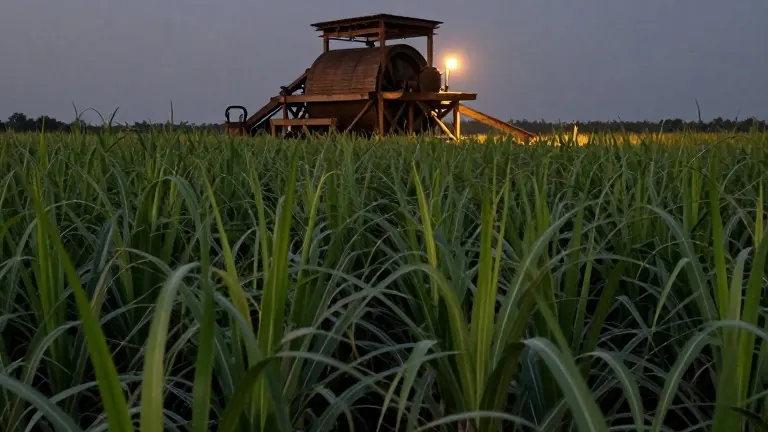
The harvest, or grinding season, ran from mid-October to late December. To keep the fields and mill in sync, owners divided the day into three eight-hour shifts. At Whitney, men like Antoine cut the cane. Women like Delphine and their children bundled the stalks for carts. Carter William Wellington drove the loads to the mill.
Inside the mill, Fanny fed cane onto a conveyor belt leading to massive rollers. Gilbert moved boiling juice between kettles in a process called the “Jamaica Train.” This system of four kettles removed impurities and water. Green, one of the sugar makers, monitored the process to prevent burning. Manual Fulford, an enslaved cooper, made the barrels used to cool the crystals.
The work continued 24 hours a day until the harvest ended. Enslaved people moved between shifts or rested for the next turn. Owners relied on their skills to maximize profit during the short growing season. The physical demands pushed workers to the limits of the human body.
The industry’s history is documented through the specific roles of named individuals. Their labor created the “white gold” that became central to Louisiana’s identity. The partnership between Verite News and Whitney Plantation historians aims to keep these details visible.
Source: Verite News