Record Spending Reshapes 2026 Election Landscape in the South
Committee-level advantages for Republicans contrast with candidate-level gains for Democrats as historic ad buys target key states.
By Eric Coleman ·
Election Day in 2026 marks a historic financial threshold for American politics. According to the Associated Press, the current cycle is likely to become the most expensive election in history. This surge in spending has fundamentally altered how campaigns operate, particularly in the South Central states where voters are deciding the future of Congress. The money flows have created a distinct divergence between what party committees are doing and what individual candidates are raising.
At the committee level, Republican organizations have maintained a significant edge. They have outraised and outspent their Democratic counterparts throughout the general election season. This financial advantage has been bolstered by support from Trump-affiliated groups and significant contributions from Elon Musk. These resources have allowed Republican committees to dominate the airwaves, particularly in areas where President Trump performed well in the 2024 presidential race.
The distribution of this spending is highly concentrated. An analysis of AdImpact data cited by the Associated Press reveals that 88.1 percent of Republican general election television ad spending went to states and districts that Trump won in 2024. Within those regions, more than 850 million dollars were spent in areas where his victory margin was ten points or more. This strategy aims to solidify support in key battlegrounds and protect Republican-held seats in the Senate and House.
Despite the committee-level disparity, the picture is different at the candidate level. Democrats have managed to outraise their Republican opponents for individual races. This candidate-level edge suggests that while the party infrastructure is spending heavily, the specific races are often close enough to require intense local fundraising. This dynamic is particularly evident in the South Central states, where margins of victory in the 2024 presidential election were relatively narrow in some key Senate races.
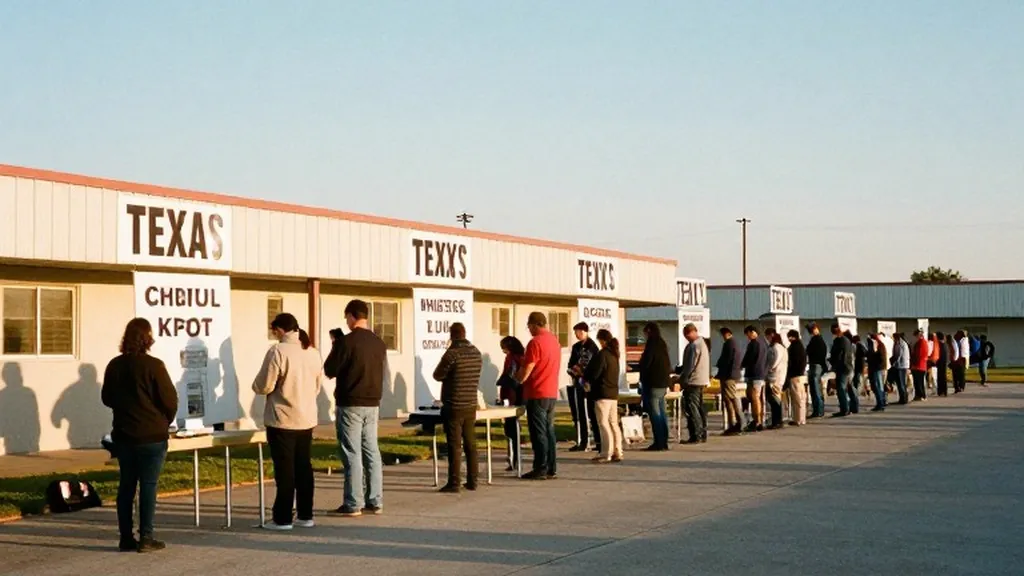
Texas serves as a prime example of this financial tension. The state holds an open Senate seat, with Republican Attorney General Ken Paxton facing Democrat James Talarico. Trump backed Paxton in the primary, signaling strong party support. However, the state also features a competitive governor race, which the Associated Press identifies as one of the key contests in the region. The heavy ad spending in Texas reflects its status as a pivotal state for both chambers of Congress.
In Oklahoma, voters are facing an open Senate seat and an open governor race. The state is part of the South Central bloc where spending has been intense. While the specific ad data for Oklahoma is not broken out separately in the headline figures, it falls within the broader category of states where Republican committees focused their resources. The polls in Oklahoma open at 7 a.m. and close at 7 p.m. local time, according to Ballotpedia. Voters in this state will decide the outcome of these high-stakes races later today.
Louisiana presents a different administrative landscape due to its unique election schedule. Polls are open from 6 a.m. to 8 p.m. for Tuesday elections, though some jurisdictions held their elections on Saturday. The state has an open Senate seat, and the lack of a governor race in this cycle means all financial and political energy is focused on the federal level. The heavy spending in this region is part of the broader effort to secure the four Senate seats Democrats need to gain a majority.
Arkansas adds another layer to the regional picture. The state is defending incumbent Republican Senator Tom Cotton and incumbent Governor Sarah Huckabee Sanders. Both races are being watched closely as part of the effort to prevent the midterm pattern where the president's party loses seats. The polls in Arkansas open at 7:30 a.m. and close at 7:30 p.m. local time. The financial edge of Republican committees is likely supporting these incumbents, although the candidate-level fundraising by Democrats remains a factor in the state's competitive districts.
The contrast between committee and candidate spending highlights the complexity of the 2026 midterms. Republican committees are leveraging their war chests to target safe seats and high-margin victories, while Democrats are focusing their candidate-level resources on tighter races. This strategy is playing out across the South Central states, where the balance of power in both the House and Senate is being determined. The 88.1 percent figure underscores just how targeted the Republican spending has been, focusing on areas where they believe they can lock in victory.
As polls remain open, the impact of this record-breaking spending will become clear in the final tallies. The $850 million figure spent in high-margin Trump districts is a testament to the scale of the investment. Meanwhile, the Democratic candidate-level edge offers a counter-narrative of grassroots resilience. Voters in Texas, Oklahoma, Louisiana, and Arkansas are casting their ballots to decide who will control Congress for the final two years of Trump's term. The financial data suggests that both parties have prepared for a long and expensive battle, with the outcome hinging on turnout and local dynamics.